Most Shopify stores run on automation. An order comes in, an email goes out, inventory updates, and the customer gets a tracking number. It works, and it works well for what it does.
But automation isn’t agentic. The difference between these two approaches is becoming increasingly important as AI reshapes how e-commerce operates, and understanding it helps you decide where to invest your time and resources.
Agentic AI doesn’t just follow rules you’ve programmed. It pursues goals you’ve set and figures out how to achieve them, adapting its approach when circumstances change. This guide breaks down what that means in practice and when each approach makes sense for your store.
The Core Difference
Automation follows a script you’ve written. If X happens, do Y.
Agentic AI pursues an outcome you’ve defined. It figures out how to achieve Z, adjusting its approach based on what it learns along the way.
Everything else flows from this fundamental distinction.
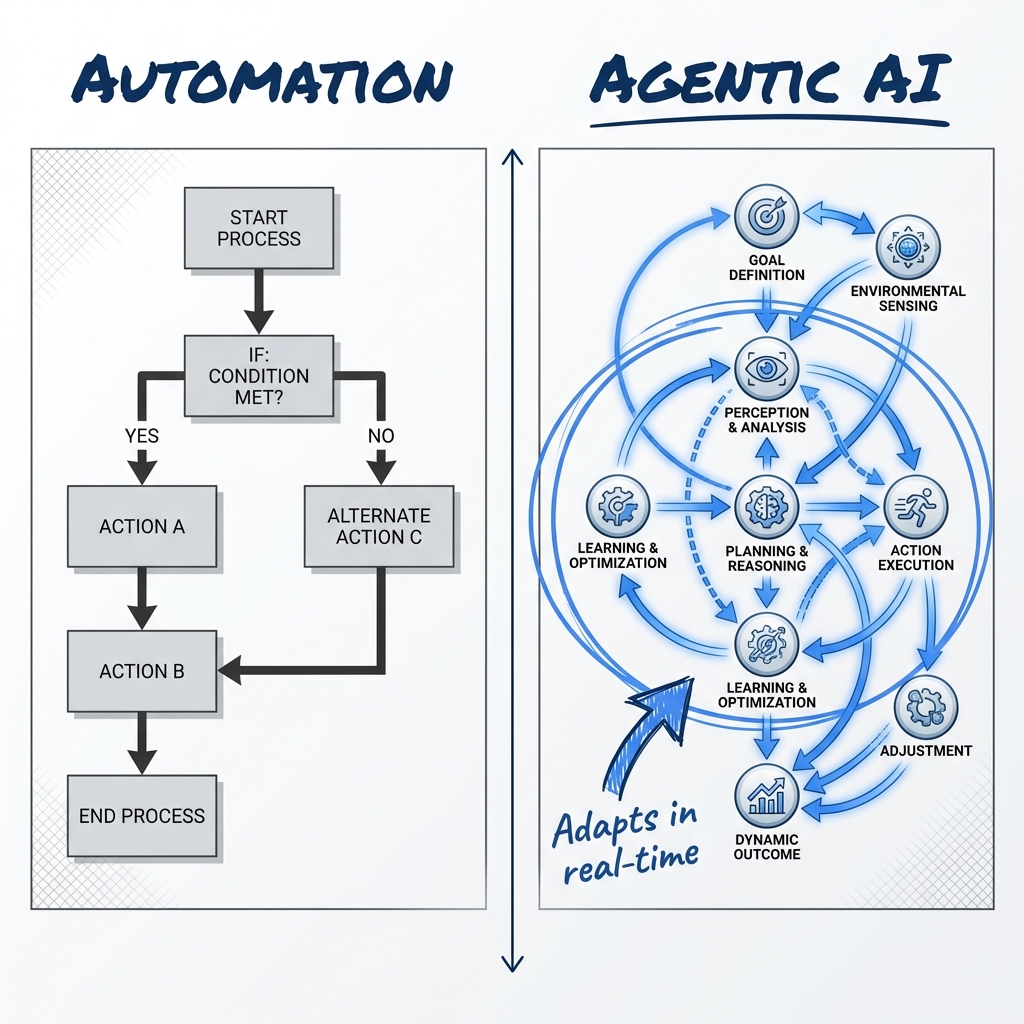
Automation is deterministic, meaning the same input produces the same output every single time. This predictability is actually valuable for many tasks.
Agentic AI is probabilistic. The same input might produce different outputs because the system is reasoning about context, weighing tradeoffs, and making decisions that account for factors beyond the immediate trigger.
Here’s a concrete example of the difference:
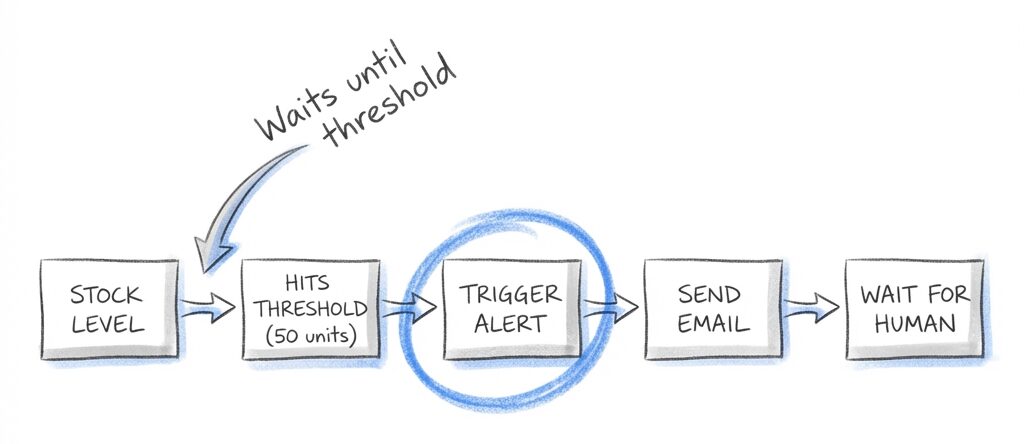
Automation: “When inventory drops below 50 units, send a reorder alert to the purchasing team.”
Agentic AI: “Keep inventory at optimal levels.” The agent determines what “optimal” means by analyzing demand patterns, seasonal trends, supplier lead times, and available cash flow. It might reorder at 200 units before a holiday rush, or hold off when cash is tight and demand is slowing.
One follows instructions you’ve given. The other solves problems you’ve defined. For a deeper look at how these goal-oriented systems work, see how AI agents function in e-commerce.
Rule-Based vs Goal-Oriented
Traditional e-commerce automation is built on rules. You define triggers, set conditions, and specify actions.
| Trigger | Condition | Action |
|---|---|---|
| New order | Order value > $100 | Send VIP thank you email |
| Cart abandoned | 2 hours passed | Send reminder email |
| Stock level | Below 50 units | Alert warehouse team |
This approach works beautifully for predictable scenarios. The logic is transparent, the behavior is consistent, and debugging is straightforward.
But rules struggle with situations you didn’t anticipate.

What happens when a product goes viral and demand spikes 300%? When your supplier delays shipments for two weeks? When a competitor drops prices by 40% overnight?
Rules don’t adapt to these situations. They keep executing exactly as written, even when the circumstances have fundamentally changed. You have to notice the problem, figure out the right response, and manually update your rules.
Agentic AI approaches this differently. You give it a goal like “maximize profit while maintaining 98% order fulfillment,” and the system figures out how to achieve that goal given current conditions.
When demand spikes unexpectedly, an agent might:
- Notice the surge in real-time
- Check supplier capacity and lead times
- Adjust reorder quantities proactively
- Consider whether price adjustments make sense
- Suggest limiting orders per customer if supply can’t keep up
None of this was explicitly programmed. The agent reasoned toward the goal you defined. This is what makes systems like Shopify Sidekick increasingly valuable as they evolve from assistants to autonomous actors.
Inventory: Automation vs Agentic
Inventory management illustrates the distinction clearly.
Automation Approach
Most stores use automated inventory alerts, and they work reasonably well. You set a minimum threshold, configure an alert when stock hits that level, and maybe auto-generate a purchase order.
This catches stockouts. Eventually.
The limitation is that it’s reactive. The system only knows what you told it, and it can’t anticipate problems before they occur.
Agentic Approach
An inventory agent takes a fundamentally different approach. Instead of waiting for a threshold to trigger, it continuously monitors multiple signals:
- Current stock levels and sales velocity
- Historical patterns and seasonal trends
- Upcoming promotions and marketing campaigns
- Supplier lead times and reliability
- Cash flow constraints and carrying costs
Then it predicts what will happen and acts accordingly.
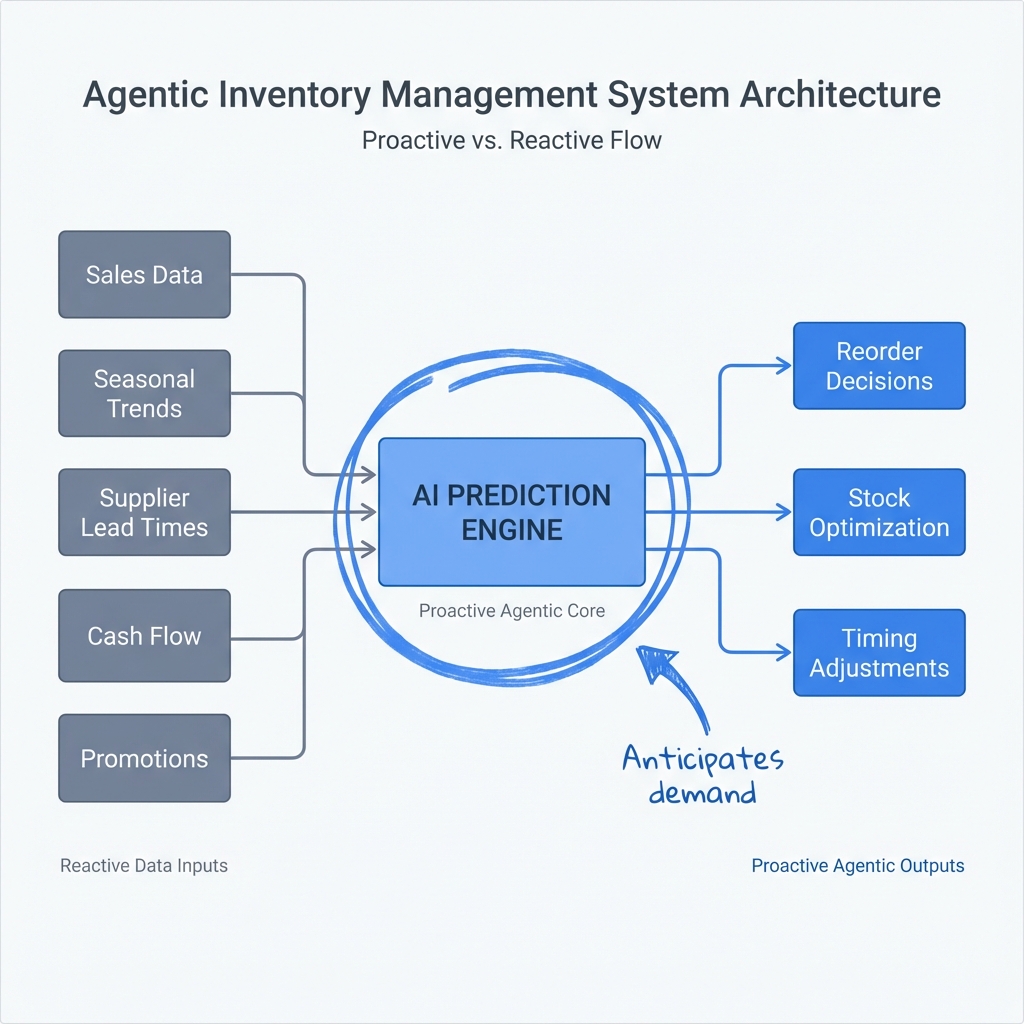
Consider a practical example: Your automated system triggers a reorder when stock hits 50 units. But an agentic system might reorder at 200 units because it noticed Black Friday is three weeks away, this product sold four times faster last November, your supplier needs two weeks lead time, and you have the cash available now.
The agent isn’t following a rule. It’s solving for the goal of not running out of stock during your busiest season.
Similarly, on the demand capture side, the difference matters. A traditional back-in-stock notification system sends alerts when inventory returns, which is useful. But an agentic approach might predict demand for out-of-stock items, prioritize restocking based on captured demand signals, and time replenishment to maximize conversion from those waiting customers.
Merchants who’ve implemented these approaches typically report 20-40% fewer stockouts and 15-30% less overstock, along with better cash flow from smarter timing.
Pricing: Automation vs Agentic
Pricing decisions reveal the difference even more starkly.
Automation Approach
Automated pricing usually means rules like:
- “If competitor price drops below ours, match it”
- “Apply 10% discount on items older than 90 days”
- “Increase price by 5% when stock drops below 20”
These rules execute exactly as written, without any consideration of context or consequences.
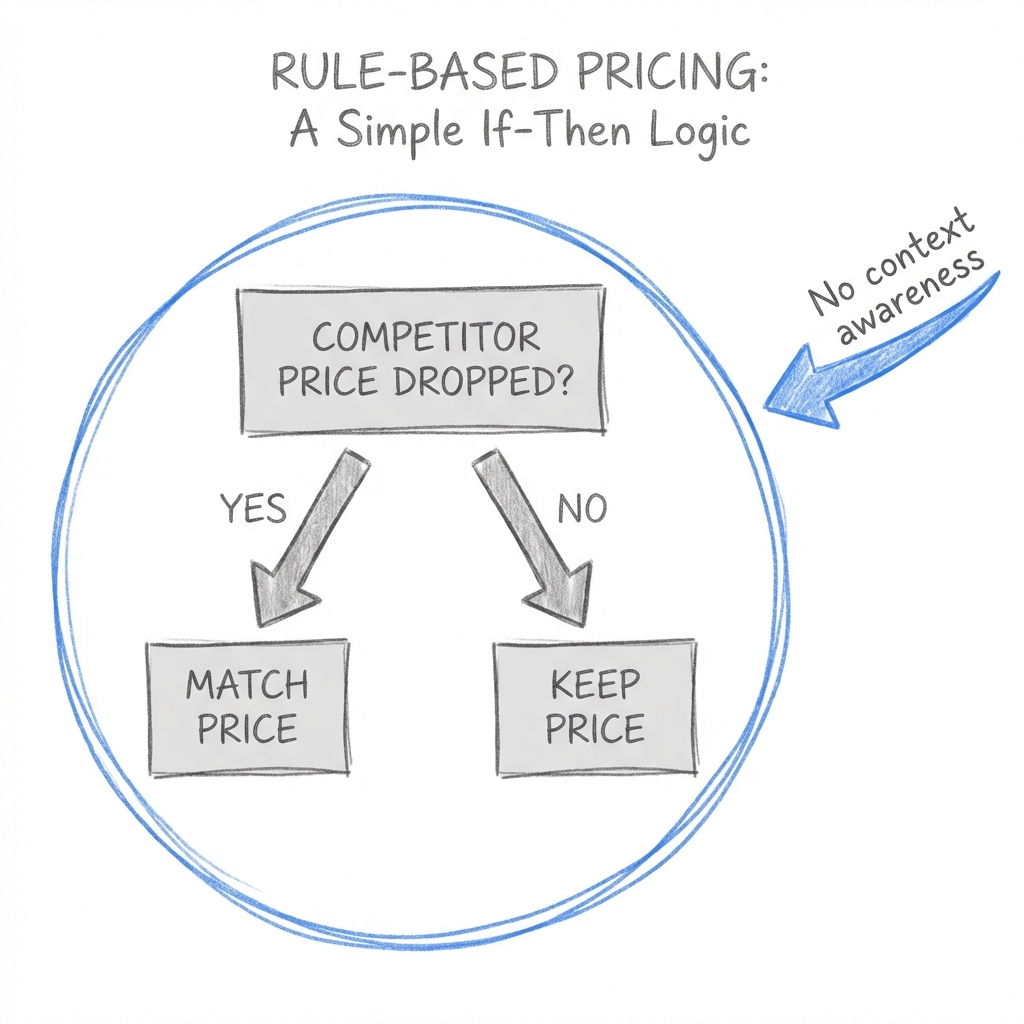
The problem is that matching a competitor’s price might destroy your margin. The 10% discount on slow movers might not be enough to clear inventory, or it might be more than necessary. The 5% increase when stock is low might drive customers away to competitors who have the item in stock.
Rules don’t evaluate whether the action they’re taking actually moves you toward your business goals.
Agentic Approach
A pricing agent optimizes toward a goal like “maximize gross margin while staying competitive in the market.”
To do this, it considers multiple factors simultaneously:
- Your actual costs and target margins
- Competitor prices in real-time
- Demand elasticity for each specific product
- Current inventory levels and carrying costs
- Customer willingness to pay based on behavior
- Your brand positioning and pricing strategy
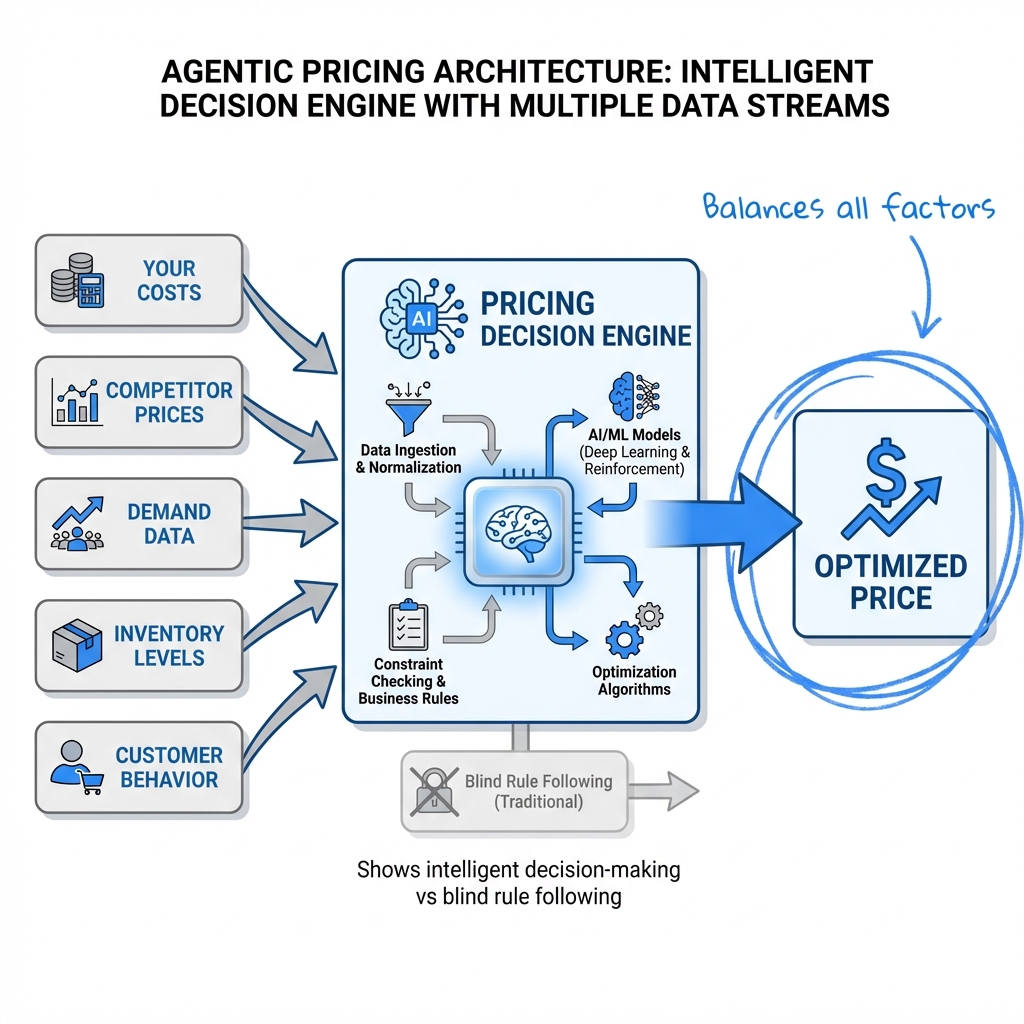
When the agent sees a competitor drop their price by $10, it doesn’t automatically match. It might notice that you’re the only seller with this item in stock, the competitor won’t have inventory for two weeks, demand is currently high, and your margin is already thin.
Decision: Hold the price, or possibly even increase it slightly. That’s the kind of contextual reasoning that rules can’t replicate, and it’s what separates goal-oriented AI from traditional automation. For more on this evolution, the Universal Commerce Protocol is building infrastructure for exactly these kinds of intelligent commerce interactions.
Marketing: Automation vs Agentic
Marketing automation is everywhere, but it has inherent limitations.
Automation Approach
A typical marketing automation setup includes abandoned cart emails after two hours, welcome sequences for new subscribers, post-purchase follow-ups on day three, and win-back campaigns after 60 days of inactivity.
Everyone in each segment gets the same sequence, the same timing, and the same content.
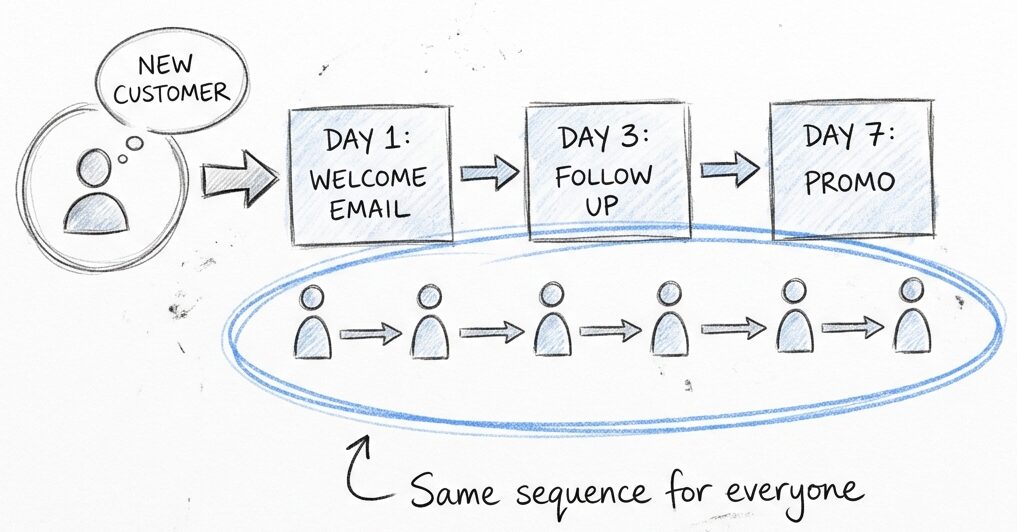
This beats doing nothing, and well-designed sequences can perform quite well. But it’s not personalization in any meaningful sense. It’s segmentation at best.
Agentic Approach
A marketing agent pursues a goal like “maximize customer lifetime value” by making individual decisions for each customer:
- Which channel will this person respond to: email, SMS, or push notification?
- What’s the optimal time to reach them based on their behavior patterns?
- What message will resonate given their history and context?
- Is an offer necessary, and if so, what’s the minimum effective discount?

Where automation sends everyone an abandoned cart email at two hours, an agentic system might determine:
- Customer A always researches for 24 hours before buying. Send them an email at hour 20.
- Customer B engages with SMS but ignores email. Skip the email entirely.
- Customer C has abandoned three carts this month. They’re comparison shopping, so offer 5% off.
- Customer D always comes back without prompting. Don’t send anything and avoid training them to expect discounts.
This level of personalization at scale isn’t achievable with rules, regardless of how sophisticated your segmentation becomes.
When Automation Is Enough
Agentic AI isn’t always the right choice. Traditional automation wins in specific circumstances.
When the process is simple and predictable. Order confirmation emails, shipping notifications, password resets, and page speed optimizations that preload content based on user behavior. These are deterministic problems that don’t benefit from AI reasoning.
When the stakes are low. Sending a newsletter at 10am versus 9am doesn’t warrant sophisticated decision-making. The incremental value doesn’t justify the complexity.
When you need absolute consistency. Legal disclosures, compliance notifications, and regulatory requirements demand the same output every time. Variability isn’t a feature here; it’s a liability.
When volume is low. If you’re processing ten orders a day, manual oversight is practical and probably preferable.
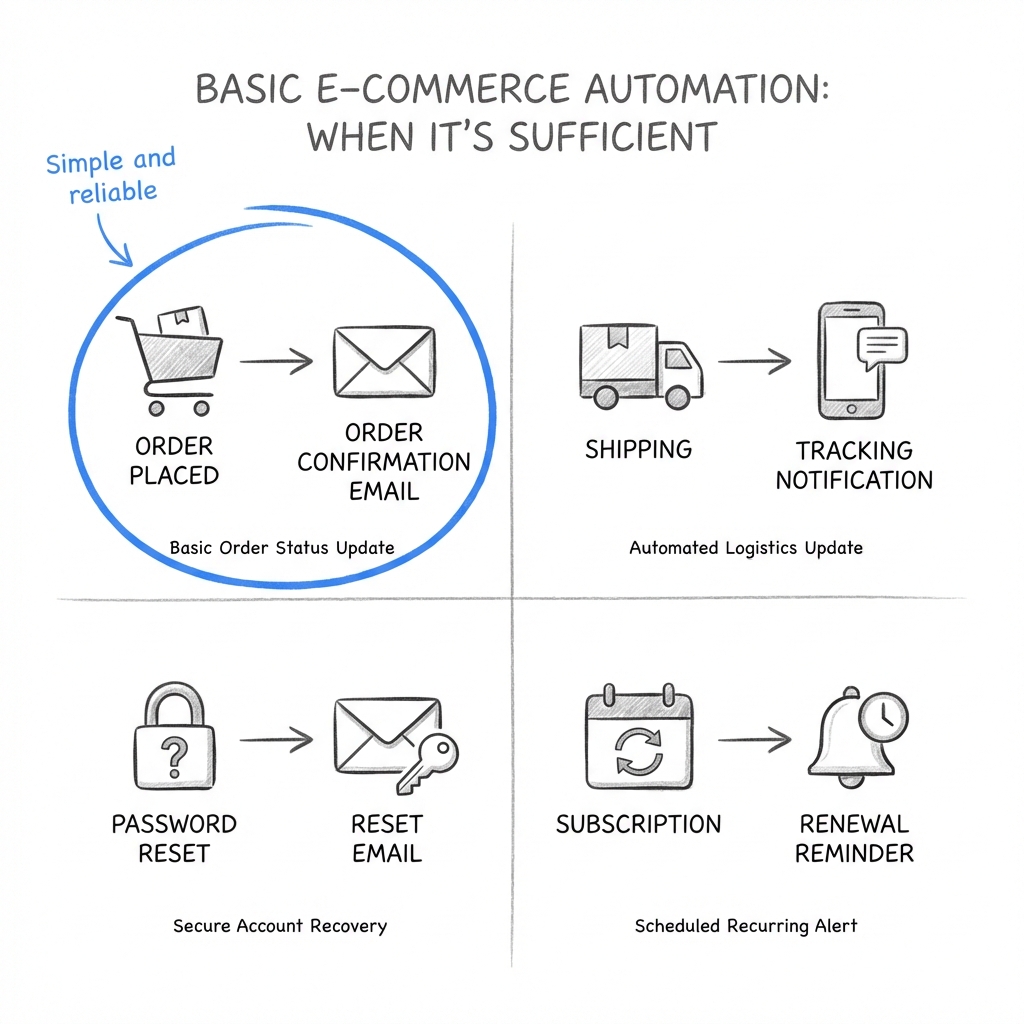
The bottom line: if rules work for a given task, use rules. They’re cheaper to implement, more predictable in their behavior, and far easier to debug when something goes wrong.
When You Need Agentic AI
Agentic AI becomes valuable when your environment has specific characteristics.
When conditions change constantly. Pricing, inventory management, and personalization all require continuous adaptation to shifting circumstances.
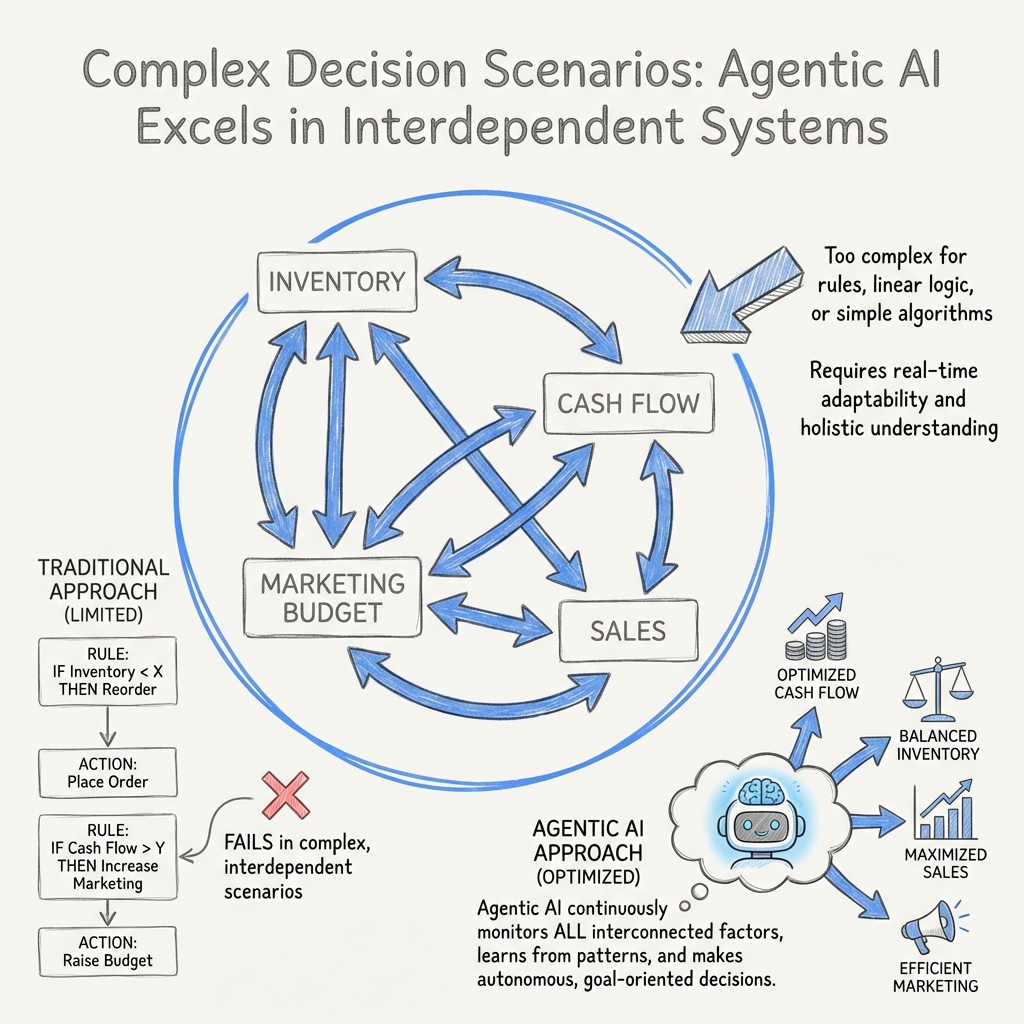
When multiple factors interact. Inventory decisions affect cash flow, which affects marketing budget, which affects sales, which affects inventory. These interconnected systems benefit from holistic optimization.
When scale matters. Personalizing experiences for 100,000 customers requires AI because no human team can make that many individual decisions effectively.
When speed matters. A competitor changed their price 30 seconds ago. Rules wait for your next scheduled check. Agents can notice and respond immediately.
When goals are complex. “Maximize profit while maintaining customer satisfaction and minimizing stockouts” requires balancing multiple objectives simultaneously. Rules can’t optimize across these dimensions; they can only follow the specific logic you’ve encoded.
The Hybrid Reality
Most stores will need both approaches working together, not one replacing the other.
Automation handles predictable, repeatable tasks where consistency matters.
Agentic AI handles complex, adaptive decisions where context and optimization matter.
In practice, this means:
- Automation handles order fulfillment workflows (consistent, documented processes)
- Agentic AI decides which products to promote (requires adaptation and optimization)
- Automation sends the actual communications (reliable execution)
- Agentic AI decides who gets what offer and when (requires personalization)
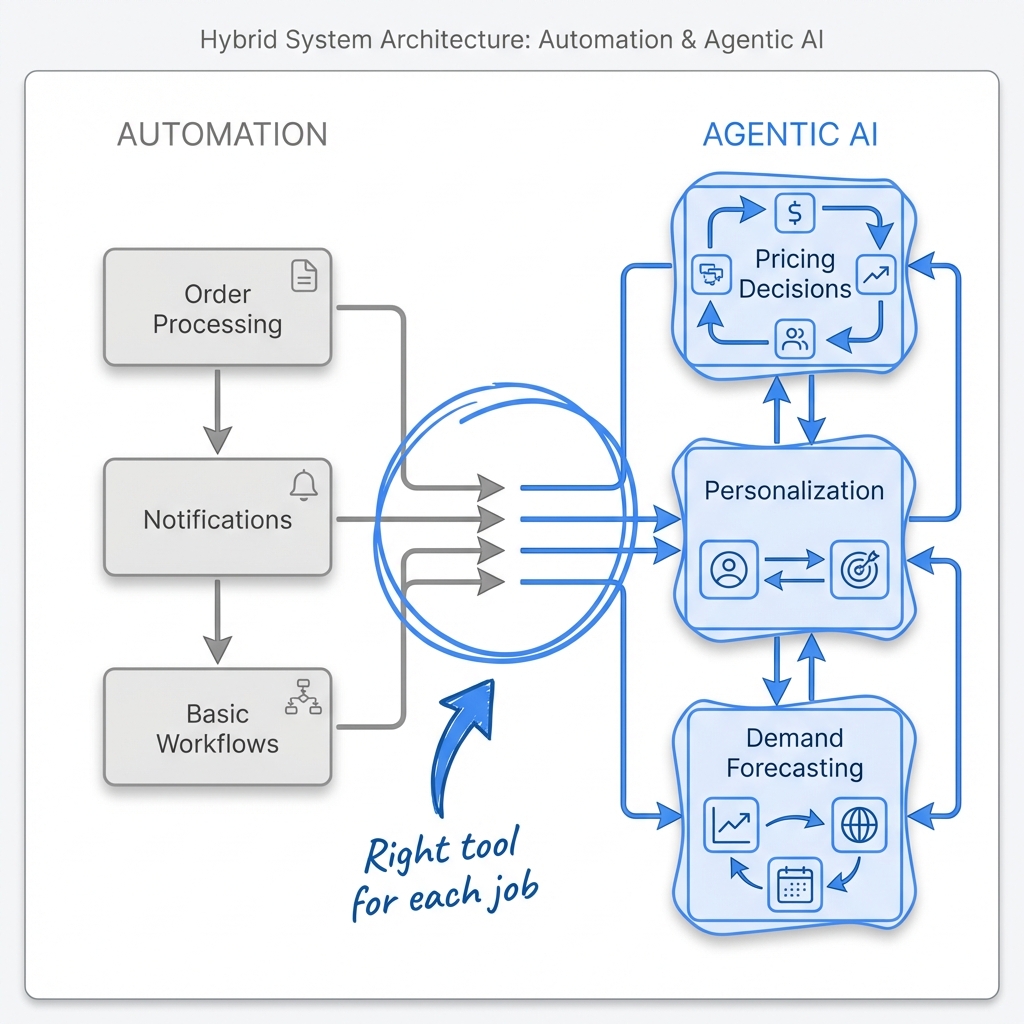
This isn’t a story of one technology replacing another. It’s an evolution where intelligent systems handle the decisions while automated systems handle the execution.
Shopify’s Approach
Shopify uses both models, and they’re increasingly intertwined.
Automation: Shopify Flow provides rules-based automation with triggers, conditions, and actions. It’s excellent for predictable operational workflows and integrates with most of the apps you already use.
Agentic: Shopify Sidekick is evolving from an assistant that answers questions to an agent that executes tasks. It can now set up discounts, configure campaigns, and analyze data with minimal direction.
The combination is powerful. Use Flow for consistent operations that shouldn’t vary, and use Sidekick for decisions that benefit from intelligence and adaptation.
As agentic commerce capabilities mature, expect more tasks to shift from rule-based to goal-based, while the underlying execution infrastructure remains automated.
Quick Comparison
| Aspect | Automation | Agentic AI |
|---|---|---|
| Logic | If X, then Y | Pursue goal Z |
| Adaptability | None | Continuous |
| Decision-making | Predefined | Dynamic |
| Complexity | Low | High |
| Predictability | 100% | Variable |
| Cost | Lower | Higher |
| Best for | Repetitive tasks | Complex optimization |
Getting Started
If you’re evaluating where to apply each approach:
1. Audit your current automation. Identify what runs on rules today: order notifications, inventory alerts, email sequences, page speed optimizations, and similar operational workflows.
2. Identify where rules break down. Look for places where you’re constantly adjusting automation, where exceptions frustrate customers, or where you wish the system was smarter about context.
3. Start small with agentic capabilities. Inventory is often a good first use case because the stakes are lower than pricing and the feedback loops are clearer. Back-in-stock demand capture is another area where intelligent prioritization can improve on simple automation.
4. Measure outcomes, not activities. Automation is easy to measure by activity: emails sent, alerts triggered, rules executed. Agentic systems should be measured by outcomes: revenue generated, stockouts prevented, customer satisfaction maintained.
5. Keep humans in the loop initially. For high-stakes decisions, have the agent recommend rather than act. You can grant more autonomy as you build confidence in its decisions and establish appropriate guardrails for AI commerce.
Frequently Asked Questions
Can automation and agentic AI work together?
Yes, and most implementations use both. Automation handles predictable tasks with reliable execution. Agentic AI handles complex decisions that require adaptation. They’re complementary, not competing.
Is agentic AI more expensive?
Generally, yes. The technology costs more to implement and operate. But ROI often exceeds simple automation because agentic systems optimize outcomes rather than just executing tasks. The question isn’t which costs less, but which creates more value for a given investment.
Will agentic AI replace my team?
Not in a straightforward way. It shifts what your team works on. Less time making routine decisions, more time setting strategy and handling exceptions. The total work may stay similar, but its nature changes.
How do I know if I need agentic AI?
Look at where your rules keep breaking. If you’re constantly adjusting automation, handling exceptions manually, or wishing the system understood context better, those are signals that goal-oriented AI might help.
What should I automate first?
Start with predictable, low-risk tasks: order confirmations, inventory alerts, customer notifications, and operational workflows. Build competence with automation before adding the complexity of agentic systems.

About Akash Radadiya